Showing posts with label political prisoners. Show all posts

Thursday, February 29, 2024

Carswell Vigil Calls Attention to Trauma Faced by Aafia and other Muslim Women Prisoners

By Nadrat Siddique

A vigil for political prisoner Dr. Aafia Siddiqui was held on February 25 outside FMC Carswell. It was called at very short notice by Nadrat Siddique, of the Women's Committee to Free Aafia. The action followed Siddique's completion of her 55th marathon at age 55. That morning she ran the 26.2 miles of the Cowtown Marathon in Fort Worth, TX, not far from FMC Carswell, where Dr. Aafia Siddiqui is caged, and came to the vigil directly from there, arriving half an hour late as a result of the prolonged exertion in the Texas heat.

Siddique said Aafia, like the huge numbers of Palestinian women prisoners being held by Israel, had been treated as a non-person, with no recognizable rights. She had been assaulted and raped on both sides of the Atlantic, and the governments and prison authorities involved were liable, since they had failed to protect a prisoner under their charge. Aafia should be released immediately, Siddique said.

El-Hajj Mauri Saalakhan, of the Aafia Foundation, was a guest speaker at the vigil. He has been coming to the Dallas-Fort Worth area for over a decade, mobilizing support for Dr. Aafia Siddiqui, whose case was initially completely ignored by most major Muslim organizations. He organized annual protests at the prison, sometimes in concert with a smattering of local Muslim groups. He said that Aafia's case was a litmus test for the entire Muslim Ummah, and that the dearth of a response to her prolonged suffering indicated that the Ummah had failed. He also called upon local imams in the DFW area to visit Aafia in prison, as it would uplift her spirits, and keep the authorities on notice that the community was alert to her suffering.

Photos from the protest are here.

#FreeAafiaSiddiqui #FreeAllPoliticalPrisoners #FMCCarswell

Wednesday, February 28, 2024

Notes from the Cowtown Marathon


I'm 55 years old, and today I ran my 55th marathon, the Cowtown Marathon in Fort Worth, Texas. It is also the 11th one I've dedicated to the cause of political prisoner Dr. Aafia Siddiqui.

She's a Pakistani woman academic serving an 86-year prison sentence in Fort Worth, TX. The evidence against her at trial was completely trumped up, and continuing to imprison her is one of the greatest crimes by the U.S. government against the Ummah.

 Since it was close to International Women's Day, I also dedicated my race to the cause of Palestinian women political prisoners. Israel currently holds 800+ Palestinian women without charge or trial. They are denied all family contact and access to counsel. Many of them have been raped, tortured, and beaten in detention. All of this is in clear violation of international rules and law, and Israel must be held accountable.

Personal notes:

 - My finish time was a miserable 4:21 (read 4 hrs 21 minutes). Still, it was (by my novice standards) not bad for an out-of-town marathon, particularly one done in my new-found role as caregiver (with the massive amounts of sleep lag that entails).

- I placed 3rd place in my division.

- The course was hilly, and traversed a good chunk of Fort Worth.

- Around Mile 8, a group of strong, fast Pakistani male runners caught up to me. I noticed them because they were talking incessantly in Urdu amongst themselves, about different marathons in Pakistan. They talked even as we were going up some of the steeper hills! One of them was Dallas-based physician Salman Khan. He was running the ultra-marathon (50k, or 31.06 miles), while pacing his friends. The other two had traveled all the way from Karachi for today's race.

- Of the two Pakistanis who had come from Karachi, one was running the ultra, while the other was doing the marathon. And these men had trained in Pakistan, with its very hot, humid climate, rolling blackouts (“load-shedding”), and adverse (in many areas) running conditions. So, they were not only fit, but had great dedication and discipline to get to this point.

- One of them later told me he was the nephew of Pasban Party chair Altaf Shakoor and lived in his house. (Pasban is a populist Pakistani political party, which advocates for workers rights and social justice. Some of its principals have been prominent in the Pakistan-based Aafia Movement.)

- So, Altaf’s nephew had seen me from time to time on his uncle’s Facebook page. Altaf himself was very active in the movement to free Aafia. Unfortunately, it didn’t appear that the nephew was involved in that, or any other social justice cause.

- I was thrilled to learn that Pakistan now hosted marathons, something that seemed like a pipe dream in the past. At the same time, it saddened me that well-trained, extremely fit Pakistani athletes like the ones I met at Cowtown, and others representing Pakistan on an official level failed to use their position to advocate for Aafia, or, it seemed, for any social justice issue. Perhaps the dual challenges of training in extremely adverse climate and getting the funding they needed to travel to far away competitions precluded them from anything but the actual race.

 - The temperature at Cowtown was 76 degrees for the last hour. That's hot for a marathon. And it didn't help that I had trained exclusively in the DC-Maryland area, where it is much cooler.

- Complete disclosure: I planned to wear my kaffiyah (Palestinian scarf) during the race, and even brought it to the start line for the purpose. But it was simply too hot. And I wimped. I put it on only afterwards.

- I was not feeling it today, and wanted dearly to quit midway through the race, but I had too many people waiting on me at the prison to vigil for Aafia afterwards. Once again the mental image of Aafia’s sweet, innocent face, swathed in her now famous yellow hijab, propelled me across the finish line.


#FreeAafiaSiddiqui #FreePalestine #FreeAllPoliticalPrisoners

Monday, December 18, 2023

Letter to the Dallas Examiner (on Dr. Aafia Siddiqui)

Soon after running the BMW Dallas Marathon for Dr. Aafia Siddiqui, I wrote a letter to the DFW area's leading Black newspaper, the Dallas Examiner. I'd had no success getting letters about my actions for Dr. Siddiqui published in major newspapers in the area, but, I had high hopes that a Black newspaper might possess a slightly different consciousness. Weeks passed, and my hopes were dashed. Not only was the letter not published, but there was no acknowledgment of its receipt.

--Nadrat Siddique

-----------------

Dear Editor,

An important event occurred earlier this month, which seems to have escaped the notice of most Dallas news media. The sister of a well-known political prisoner was finally allowed to visit her. The prisoner is a Pakistani woman educator named Dr. Aafia Siddiqui. She is a very unusual prisoner, in that she is a PhD with degrees from MIT and Brandeis, and prior to being locked up, she was developing a novel educational methodology for children with autism and other learning disabilities.

She was on the brink of presenting her ideas to appropriate bodies in Pakistan, when she was kidnapped by security forces from Karachi, She was shot in the abdomen, repeatedly raped and tortured in secret prisons in Afghanistan (then being run as part of the U.S. “War on Terror”), and ultimately brought to the U.S. for trial. Although she was convicted by a New York court in 2010, there is hard forensic evidence that she could not have committed the crime of which she was accused.

The unusual event I mention is the Texas visit of Aafia’s elder sister, Dr. Fowzia Siddiqui. Fowzia, is a Harvard-educated physician with a focus on neurology and epilepsy, and is based out of Karachi, Pakistan. She traveled the 8,300 miles from there, along with Pakistani Senator Talha Mahmood and U.K.-based Aafia Attorney Clive Stafford-Smith, to see her sister, only to be told by the prison, FMC Carswell, that they couldn’t locate the key for the visitation cell! So, the meeting was canceled for that day, and Fowzia left the prison distraught.

The following day, the prison allowed the sisters to meet, but, the meeting was much shorter than agreed upon by prison authorities, and despite the promise of a “social visit,” no contact was allowed between the sisters.

A day later, Attorney Clive Stafford-Smith met with Aafia. Aafia told him she had been raped while at FMC Carswell! As the visit came to an end, Aafia was crying for Clive not to leave, as she was deadly afraid to return to her cell for more abuse.

In and of themselves, her allegations are not surprising, given the multitude of lawsuits brought by female inmates alleging sexual assault and rape against the prison. In fact, the allegations were so widespread that FMC Carswell was included in a 2022 U.S. Senate investigation on abuse of female inmates at FBOP facilities. But, it is gut wrenching for Aafia’s ultra-conservative, close knit family of academics that not only prison authorities present  numerous road blocks to their visits, which are guaranteed under FBOP regulations, but that their sister, after already being raped in Third World prisons, is once again undergoing such “Cruel and Unusual” punishment at a U.S. prison hospital.

As a Pakistani multi-marathoner and political prisoner advocate, I ran the BMW Dallas Marathon on December 10 to call attention to Aafia’s case. I wore a tee which said, “Free Dr. Aafia Siddiqui!” It was my 54th marathon all told, and my tenth for Aafia. I truly hope people in the Dallas area will think about the horrors being visited upon this innocent woman in the midst of their Christmas merry making. Is this what Jesus (Peace Be Upon Him) would have wanted?

Sincerely,

Nadrat Siddique

- - - - - - - - - - - 

Nadrat Siddique is a Pakistani woman marathoner based out of the Washington, DC area. She is a member of the Jericho Movement, which advocates for political prisoners.

Saturday, September 23, 2023

September 23: A Day of Infamy

By Nadrat Siddique


Pakistani scientist Dr. Aafia Siddiqui has been held longer than Aleksandr Solzhenitsyn was in Russia's Gulag. She has been imprisoned longer than Russian physicist Andrei Sakharov was in (internal) exile. She has been held about the same length of time as well-known Chinese physician and pro-democracy leader Wang Bingzhang. In fact, like Aafia, Bingzhang was abducted in one country, then taken to another for a kangaroo court trial, convicted, and effectively buried by his captors.


In Bingzhang's case, the U.S. registered vociferous protests against the Chinese government. And yet, the U.S. continues to allow the torture and detention of Dr. Aafia Siddiqui.


Not one person died or was injured in the incident in Ghazni, Afghanistan, in which Aafia was charged. In fact, she should never have been in Afghanistan in the first place. Aafia was kidnapped by Pakistani and U.S. intelligence services, and forcibly taken there from Pakistan- in violation of international law. In other words, if international rules and norms had not been trashed by the security agencies in question, the (concocted) incident for which Aafia was charged would not have arisen.


And yet, on September 23, 2010, the MIT alum was sentenced to 86 years in prison. A brilliant scholar, with innovative ideas to uplift Pakistan's education system, she continues to languish at FMC Carswell, where other political prisoners, eg Lynne Stewart and Reality Winner, have also been held.


Does the U.S. have no shame in continuing to hold this innocent woman scientist/ educator, all the while protesting the detention of scientists, writers and academics in other countries? Today on this day of infamy, September 23, we say "Free Aafia Siddiqui now! Free all political prisoners!"


#FreeAafiaSiddiqui #BlackDayforPakistan #DrAafiaSiddiqui #FreeAllPoliticalPrisoners

Friday, March 3, 2023

Farheen Siddiqui Runs for Aafia at the Cowtown Running Festival

By Nadrat Siddique

I am incredibly proud of my young Pakistani-American sister-friend Farheen Siddiqui. In December, she and I, along with some of her family members, participated in the BMW Dallas Marathon Festival, a gargantuan athletic event which brings out tens of thousands each year. At that event, Farheen and I wore our respective shirts calling attention to the unjust imprisonment of Pakistai female scientist Dr. Aafia Siddiqui.

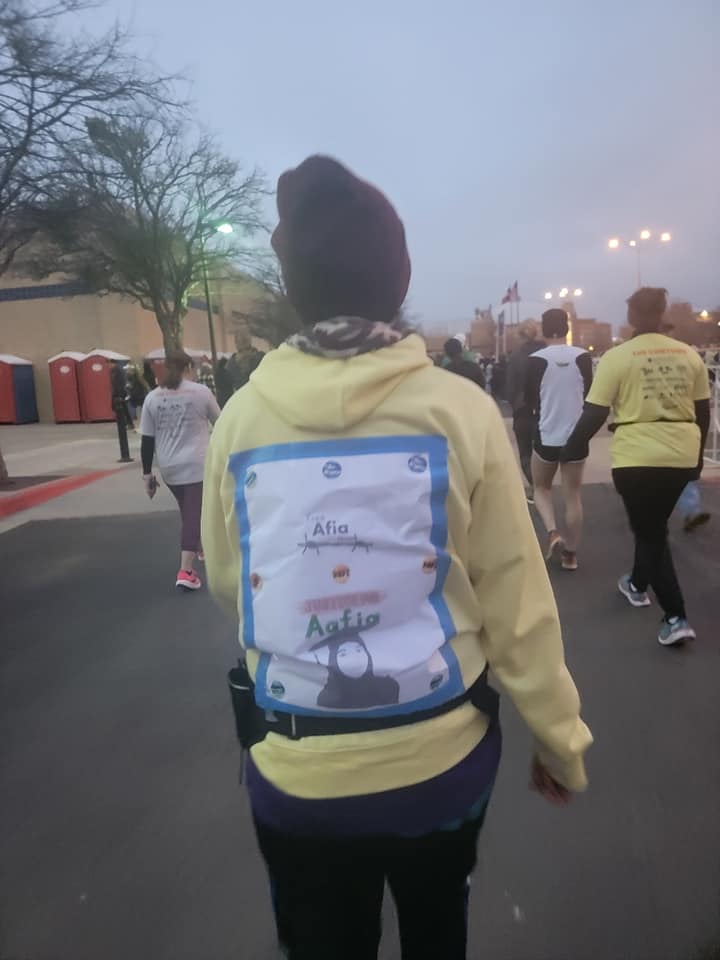
This time, Farheen ran/walked the 10k which is part of the Cowtown Running Festival in Fort Worth, TX, completely on her own, to call for Aafia's freedom. A few weeks before the event, she had ordered a hoodie with a graphic calling for Aafia's freedom. Unfortunately, it arrived devoid of the desired logo. Undeterred and determined to run for Aafia's freedom, Farheen made her own graphic and attached it to her sweatshirt. She then ran and walked the 6.2 miles in the chilly 40 degree temps, drawing questions and interested looks from fellow runners.

Farheen did that in what is a very "red state," with an open carry law, and an abundance of anti-Islam bigotry. If you truly follow the Islamic maxim of "Innal hokmo illah lillah" (Authority belongs to Allah alone), then you are unafraid. And there is always something you can do to stand up for justice, and against injustice. Ma'ashallah! Congratulations to Farheen!

(Fort Worth, where Farheen did her most recent race, is very near where Dr. Aafia Siddiqui is serving her 86-year prison term on bogus charges. Dallas, where Farheen and I ran in December, is the much larger, neighboring city.)

#FreeAafiaSiddiqui #FreeAllPoliticalPrisoners #cowtownmarathon

Wednesday, November 10, 2021

Fort Worth Marathon for Aafia

By Nadrat Siddique

November 8, 2021
Fort Worth, TX

This weekend, I ran the 26.2 mile Fort Worth Marathon (race) to call attention to the glaring injustice of Dr. Aafia Siddiqui's imprisonment in that town. For the crime of being an unapologetic Muslimah, she's serving an 86-year term. That means--if the authorities have their way--she may still be in prison after most readers of this post are dead.

Before her imprisonment, she was super-conservative; very family-oriented; and well known and active in her community, local mosques, and student organizations. And she was very focused on intellectual pursuits, earning advanced degrees from MIT and Brandeis in a short time.

I'm not sure how Aafia would view the enormity of my traveling 1,400 miles from the Washington, DC area to Texas to run a marathon in her name, and that, too, in funky red tights.

Some photos of my Fort Worth Marathon for Dr. Aafia Siddiqui are here.

The marathon, interestingly, is run on a portion of the Trinity Trail. This is part of a  huge system of trails- over 100 miles in total- called the Trinity Trails System. It is so expansive that you can basically travel the entire city on foot, bike, or rollerblade, relying solely on the trail.

During the marathon, an approximately 6.5 mile segment of the trail is traversed 4 times. Much of the route is flat and follows the Trinity River. I saw egrets, herons, and other waterfowl as I ran, repeatedly murmuring "subhanAllah" to myself. Along the way, there were water and Gatorade stops--and Saleema Gul.

What Gul Did

Saleema Gul, a staunch supporter of Aafia, came out to assist me in my marathon effort. In October, she'd helped organize a protest for Aafia (one of a five-city mobilization) outside the Pakistan Consulate in Houston, despite the strong objections of consular officials, including the CG, Abrar Hashmi. Seemingly in an attempt to disavow responsibility for the Pakistan government's essential role in Aafia's abduction from Karachi, and then her transfer to U.S. authorities for torture, the Consulate insisted that the protest not occur near their premises. "Any location but the Consulate" was the message. The Aafia Foundation and its coalition partners went ahead with the Pakistan Consulate protest anyway.

This time around, Gul again showed that she had more guts than most men. Fort Worth is nearly four hours from Houston. The Houston-based Gul woke up around 1:00 AM, chugged down some coffee, then jumped in her car and headed to Fort Worth. She was at the race with her "Free Aafia" sign well before me--and I was staying in a hotel literally 15 minutes away!

While I was running (sporting my "Free Aafia Siddiqui tee, prepared for me by an all-women's collective in Indiana), Gul was busily explaining Aafia's case to numerous bystanders.


As I passed by her, I was a bit concerned that she, a petite Pakistani hijabi, was standing in the midst of a largely White, largely pro-Republican crowd rocking a "Free Aafia" sign. And- Texas has an open-carry law. In other words, guns can legally be carried in plain view, on one's person in public places. Pro-Trumpers and others were known to use the provision to their advantage. Gul did not seem to be the least bit concerned. Afterwards, she told me the reception she got was generally positive, and that people were polite--even friendly--in some cases.

Torture in the Shadow of the Trinity

In the DFW area, everything seems to be about Trinity. As mentioned, there's the Trinity Trail, which runs along the Trinity River. Then, there's Trinity Park, Trinity Springs, Trinity High School, and Trinity Valley Middle School. There are churches of all denominations bearing the name Trinity. Then, there's Trinity Spine and Orthopedics, Trinity Valley School of Ballet, and Trinity Self Storage.

There is even a portion of the Trinity Trail a stone's throw from FMC Carswell, the prison where Aafia is held.

Although my understanding of the Trinity (in Christian belief) is limited, I do know that Jesus (AS) is a crucial component of this. To Christians, he is the Son (ouzo-billah). To Muslims, he is the revered messenger of God, sent to the people of his time to bring them to God's Word.

In either case, Jesus, like Aafia, was tortured horribly by the authorities of the time. And, like Aafia, he did not give up his faith under torture. 

As I left Fort Worth, I wondered what Jesus would say if he knew of an innocent Pakistani Muslim woman's continued abuse in an ostensible prison hospital, in the area popularly known as the "Bible Belt." Would he sanction Aafia being forced by her jailors, to walk on her holy book, Al-Qur'an?

#FreeAafiaSiddiqui #FortWorthMarathon #RunningForJustice #IAmAafia #FreeAllPoliticalPrisoners 

© 2021 Nadrat Siddique
-------
Nadrat Siddique is a Pakistani Muslim woman marathoner who lives in the Washington, DC area. She has done 48 marathons, frequently combining her twin passions of advocating for political prisoners and distance running by doing marathons to draw attention to political prisoners' cases. Previously, she did two Boston marathons, two Chicago marathons, and a Washington, DC marathon to draw attention to Dr. Aafia Siddiqui's case.

Monday, September 27, 2021

Aafia More Guilty than Chauvin?

So Derek Chauvin, the cop who killed George Floyd--in broad daylight and on camera--got a prison term of 22.5 years. And he's appealing, so, if the pattern of police impunity holds, he may get out. Pakistani scientist #AafiaSiddiqui, killed no one and injured no one. But she got 86 years. Where is the justice in that?

Sunday, April 21, 2019

Running While Muslim, Running for Aafia

By Nadrat Siddique

Special to the New Trend

It was Patriot’s Day Monday in Boston, and I ran through torrential rain from my hotel to the Boston Common two miles away. I was there to run my second Boston Marathon, calling attention to the case of a small, slight Pakistani Muslim woman neuroscientist, being held political prisoner by the United States. Her name is Dr. Aafia Siddiqui.

Boston is very odd as far as marathons go, for three reasons. For one, unlike nearly all other races, which are held on the weekend, Boston is held on a Monday. And that Monday is nowhere a holiday except in Boston.

Secondly, the race starts for most runners—depending on one’s assigned start time—around 10:30 or 11:00 a.m., very late by racing standards. Nearly all other races start around 7:00 or 8:00 a.m., with some starting as early as 6:00 a.m., both to avoid the heat of the day, and to minimize traffic blockages. The late start means that a majority of Boston Marathon runners do the bulk of their running in the afternoon heat, which raises the specter of serious health risk.

The third major oddity about Boston is that the course is one-way, as opposed to a loop, or multiple loops, like most marathons. On race morning, we runners gathered at the Boston Common to be bused to the tiny town of Hopkinton, approximately 26 miles west of the city.  Once there, in what seemed a no-man’s land, we were, at our assigned time, to run our way back to Boston. In between were a multitude of colleges, hills, and screaming fans. The fans lined every mile of the course, making the race extremely boisterous. It is decidedly not the place for an introvert. The runners were overwhelmingly White, as were most of the fans. There were, relatively speaking, a small number of Asian and light-skinned Latino runners.

The race was sponsored by the financial giant John Hancock. The founding father’s name was everywhere, proudly plastered on our marathon medals, mylar blankets (reflective blankets given to runners post-race to prevent hypothermia), and other marathon paraphernalia and memorabilia. There was no discussion of the fact that Hancock, like the other founding fathers, was a slave owner.

In the Boston Common, we runners went through a checkpoint, to get to the yellow school buses which would carry us to the race start. We were told precisely what type of bag (clear plastic) could be carried on the buses. Grateful to be out of the rain, we boarded the buses under the direction of volunteers. The twenty-six mile bus trip took close to an hour. It provided a welcome opportunity for runners to dry off.

Once in the very white Hopkinton, we went through an additional checkpoint to the starting area. Repeatedly, it was emphasized that only the clear plastic bags provided by the race organizers could be used for bag check (ie to allow runners to leave essential items needed after the race in a common but secured holding area). Automated announcements repeated ad naseum that unattended bags (along the course) would be confiscated by authorities and might be destroyed. A large number of metropolitan police, as well as some military police with submachines (the number of the latter had diminished significantly since the 2017 race, which I’d run) lined the course. Army snipers were positioned on rooftops in Hopkinton and at various points along the course.

Many of the athletes represented corporate teams. These names, e.g. Dana Farber, were pre-printed on runners’ singlets (sleeveless running shirts). As I ran, I heard the corporate names yelled out frequently by spectators, far more often than individual names. To me, this was yet another indicator of the stranglehold of corporate culture in the U.S. At many smaller races, spectators call out runner’s names (sometimes printed on the runners bibs) as they pass. Or, they call out the runners’ bib numbers, or other identifying nouns based on runners’ attire to encourage them. Not so at Boston. Unlike at previous races where I’ve worn the same shirt, nary a person yelled for me, “Go Aafia!”

Some runners ran in memory of a deceased family member, whose name they wore on their shirt. A few had country affiliation on their shirts. The most interesting were the visually impaired runners. According to statistics which I read later on the race website, these numbered 44, and required a guide companion. Each runner/ guide pair held opposite ends of what looked like a connecting plastic bag to keep them together, with the guide wearing a tee saying “Blind Runner.”

No other runners, as far as I could tell by observation and later research, ran for a political prisoner. And this year, like the last, there appeared to be few, if any other Pakistani women. As I said the last time I ran Boston, I could only run this race for Aafia. It pained me, as I ran past the turnoff to M.I.T., where Aafia had once studied, to think of this petite woman, beloved mother of three, and star scholar, suffering in a tiny Texas prison cell for a crime she clearly did not commit. But—what pained me the most was that Muslims, even those who knew her during her time in the U.S., and all Muslim organizations, except for Jamaat al-Muslimeen and the Aafia Foundation, were willfully silent on her suffering. And silence is still complicity.

By now, I have run two National (Washington DC) Marathons, a Chicago Marathon, and two Boston Marathons in Aafia’s name. (All told, I have run 42 marathons, but many of them have been for my own personal edification/ challenge, which I also view as important.) I am obviously not a professional athlete, or particularly fast. My best mile time is 7:18, run at the International 5K in Columbia, MD, where I represented Pakistan (unofficially).

I am not paid by anyone to run for Aafia or other political prisoners. I run for them because I believe it is a fundamental part of my faith, Islam, to stand up for the oppressed.

The Qur’an says in Surat-ul Balad, “And what is the Ascent? It is to free a slave.” I view it as my responsibility to fight for the freedom of the modern day slaves, the political prisoners, whose existence, while denied by the U.S. government, is an unfortunate reality under the system of White Supremacy and the congruous imperialist wars.

In that capacity, I traveled to the Black Hills (SD) and Plymouth (MA), to run for Leonard Peltier; to Salt Lake City (UT) and Hyannis (MA), and to run for Mumia Abu Jamal (Black Panther political prisoner); to Chicago to run for Aafia; to Wilmington to run for (then-) Bradley Manning (Wikileaks whistleblower turned political prisoner); and now again to Boston to run for Aafia. There is always a way to speak out when grave injustice is occurring, however one chooses to do it. And for me, it is through running.

#FreeAafiaSiddiqui #FreeAllPoliticalPrisoners #BostonMarathon2019 #RunningForJustice

© 2019 Nadrat Siddique

This article first appeared in New Trend, April 21, 2019

Saturday, October 6, 2018

One Woman for Aafia


 By Nadrat Siddique

October 5, 2018
Chicago, IL

As I was in Chicago to run the Chicago Marathon for Dr. Aafia Siddiqui, I decided a stop at the Pakistani Consulate was in order. The Consulate is located on the seventh floor of a high rise building on Michigan Avenue, a vibrant and bustling street in Chicago's downtown. Interestingly, there didn't seem to be any other consulates in the area.

Just as I arrived, a Black Lives Matter (BLM) protest passed, proceeding quickly onto E. Wacker Avenue (the site of many of the organization’s protests). The protestors chanted slogans deriding the killer police. Earlier that afternoon, in a radical departure from the norm of impunity, a police officer was convicted in the death of an innocent Black man. I itched to join the BLM march, but knew I must fulfill the purpose for which I had come to Chicago: to call attention to the case of Dr. Aafia Siddiqui, an innocent Pakistani Muslim woman scientist entering her 15th year of illegal detention. As the BLM march disappeared from view, my heart went with it.

I stood in front of the Pakistan Consulate, a silent one-woman protest, my sign calling for Dr. Aafia Siddiqui's freedom. The security guard, a heavy set Black man asked me to move away from the building. He gestured that I should stand closer to the Starbucks which was next door. I naively told him I was there for the Pakistan Consulate, and not Starbucks. He insisted I move away from the Consulate entrance. I really didn't want to be in front of Starbucks, so I re-positioned directly in front of the Consulate, but closer to the street side.

The only problem was that the street side was lined with police officers. Chicago panicked whenever Black people marched for justice. The heavy police presence there was in anticipation of "riots," Orwellian Double-Speak for Black protesters making Whites uncomfortable.

I was not eager to be in close proximity to the cops, so I temporarily moved towards Starbucks. Thankfully, the cops cleared out shortly thereafter, and I returned to my position closer to the Consulate.

As it was late Friday afternoon (the one woman protest for Aafia was 4:00 - 6:00 PM), I saw only a small handful of Pakistani officials emerge from the building. A few glanced in my direction, but it was not clear if I made a dent.

Soon after I arrived, a Pakistani couple passed me and went into the Starbucks. The wife was in full niqab. They remained in the coffee shop for some while. When they came out, I was in plain view in front of the Starbucks. They did not bat an eye, and continued on their way.

During the two-hour protest, hundreds, if not thousands, of  pedestrians walked by me. Others were in cars or buses. Many of those on foot turned around for a second look at my sign. A few cars honked their horn for me to turn toward them, so that they could read my sign (if it was not oriented in their direction at the time that they passed). Many made eye contact, which I returned with a smile. Some gave me a nod or a thumbs-up.

The ordinary (ie non-consular) Pakistanis who passed by were of two extremes: The first group were those who were overtly interested, and stared or turned around for a second look at my "Free Dr. Aafia Siddiqui" sign after they had passed. The second group was completely disinterested (or at least feigned disinterest).

I was surprised to see how many of the passersby were extremely fit runners. They were there to run the Chicago marathon that Sunday. They came from all over the country, and were notable by the race packets--distributed by all major races--slung over their shoulders. Many of them wore Boston Marathon jackets, indicating they had completed that illustrious race. Others wore the blue-colored 2018 Chicago Marathon commemorative shirt. Many of the runners passed my one-woman "Free Aafia" protest with looks of interest on their faces. We runners--particularly marathoners--tend to be very narcissistic. Also, marathons charge on average $100 registration fee, making marathoning an expensive hobby, and as a result largely the dominion of the well-to-do. I wondered how many of my fellow Chicago Marathon participants would stand for a cause higher than themselves, particularly a political prisoner whose false imprisonment their tax dollars subsidized.

As it was my first visit to the Pakistani Consulate, I didn’t realize it lay in the path taken by many marathoners leaving the McCormick Center (where packet pickup for the marathon was held). The marathon had not even started, and inadvertently I’d introduced a large number of runners to the Aafia case.

As I left the Consulate and headed to the nearby subway station, I prayed that the newly elected Pakistani government would reverse the ignominies of its predecessors, and work to free Dr. Aafia Siddiqui. It was a shame and a travesty that a Muslim nation had allowed one of its most innocent and vulnerable citizens to languish for 15 years in American, Pakistani, and Afghan prisons, all without just cause. I prayed that all those complicit in her torment would be punished by Allah Almighty.

© 2018 Nadrat Siddique

Sunday, June 3, 2018

Dr. Aafia Siddiqui Supporters Hold Iftar, Pray for Her Release


By Nadrat Siddique

June 1, 2018

Baltimore, MD – Very nearly half way through Ramadan, supporters of Dr. Aafia Siddiqui held an iftar in her honor.  Close to 30 committed Muslim activists from DC, Maryland, and Philadelphia discussed her case, made du’ah for her (and for other Muslim political prisoners), performed maghrib prayers, and shared dates and a Middle Eastern meal.

Dr. Aafia Siddiqui, a petite Pakistani Muslimah, is a political prisoner of the U.S. government. By all accounts, she has been raped, tortured, and separated from her school age children—who were also detained for years—in the course of her incarceration. Aafia is a neuroscientist with degrees from Brandeis University and MIT. She is being held as if she is a dangerous criminal in Carswell, TX, on trumped up charges which include attacking U.S. servicemen in Afghanistan. But supporters, like the ones gathered at the Baltimore iftar tonight, say the charges are preposterous, and that even the U.S. government knows it erred in its dealings with her, but is too arrogant or stubborn to reverse its actions.

Dr. Kaukab Siddique, an independent Pakistani journalist, who also teaches journalism at Lincoln University, was at the iftar. He had been writing about Aafia’s case almost since its inception. In opening remarks to the iftar, Dr. Siddique referred to the Muslim organization he helped found decades ago: “Jamaat al-Muslimeen has always been in the forefront of fighting for Muslim women’s rights under the rubric of Islam, and women have often been at the helm of the organization.”

He recognized Ashira Na’im, Masjid Jamaat al-Muslimeen administrator; Sr. Chekisha El-Amin, a long-time Baltimore-based Jamaat al-Muslimeen activist; Nadrat Siddique, a DC-based Jamaat al-Muslimeen activist and political prisoner advocate; and Sr. Fatima Abdullah, a founding member of the organization, who, along with her husband Amin Abdullah, had come to the iftar from Philadelphia, PA.

“And Jamaat al-Muslimeen has always supported political prisoners, those who are imprisoned unjustly or because of their beliefs. So, when we learned of the plight of Dr. Aafia, it was only natural for us to support her case,” he concluded.

Mauri Saalakhan, a long time DC-based human rights activist and head of the Aafia Foundation (formerly known as the Peace and Justice Foundation) was the guest speaker at the iftar gathering. He had travelled to several continents to raise awareness of the Aafia case, and organized rallies for Aafia outside the Carswell, Texas prison where she is being held—on very hostile turf, as well as at the Department of Justice, Bureau of Prisons, and other key locations.

Saalakhan said that it was the Islamic responsibility of Muslims to speak out against injustice, particularly during Ramadan. The organizer-activist, who is also known as El-Hajj Mauri Saalakhan because he has completed the Muslim pilgrimage to Mecca, had worked on a litany of political prisoner cases. But—Aafia’s case, he said, was one of the worst cases of injustice he had seen. She was alive, he said, negating the recently circulating rumor that she had passed away. But she was not well. She was held under sordid conditions, a travesty of justice, he said.

Saalakhan said he was very disappointed by the lack of action on the part of most Muslims to come forward. Muslims who could have done something to help Aafia, but didn’t—would be held accountable for their inaction in the Hereafter, he told iftar attendees. He pointed out the Pakistani government’s insidious role in first aiding Aafia’s kidnapping, and then subverting efforts to release her.

Imam Ali Siddiqui, a lifelong peace and justice activist currently based in DC, attended the iftar along with his family. His organization, the Muslim Institute of Interfaith Studies and Understanding, has effectively dialogued with churches and synagogues in the DC area. Addressing the iftar gathering briefly, he mentioned recent work with the DC Poor Peoples Campaign, a rekindling of Dr. Martin Luther King Jr.’s movement for social justice. Imam Siddiqui has long protested Aafia’s detention as well as that of other political prisoners, and participated in rallies and meetings to free her.

This writer, DC-based blogger, runner, and activist Nadrat Siddique organized the iftar. Siddique, who has run three marathons to call attention to Aafia’s case, said that as Muslims were eating and praying, praying and eating—at many, many iftars throughout Ramadan, they ought also think about the Muslim prisoners and political prisoners, being held under horrendous conditions in American prisons and secret prisons. What were the prisoners eating for iftar? Were they even conscious and able to fast? If they were fasting, did they have access to halal (Islamically permissible) food with which to open their fast?

“Muslims ought to ask the imams of their respective masajid to mention the political prisoners in their khutbas. We should write letters raising concern for the welfare of the political prisoners to corporate media, and on the social media sites of these corporate media. Give zakat to the families of the political prisoners. And make du'ah for them. There is added barakat in doing this during Ramadan,” she concluded.

Dr. Kaukab Siddique closed out the evening with a du’ah asking for the acceptance of the fasts of the iftar attendees, and remembering all the political prisoners, including Dr. Aafia Siddiqui.

© 2018 Nadrat Siddique

Saturday, April 14, 2018

Maintaining the Silence on Aafia


What do the Washington Post, the Boston Globe, and (the Pakistani daily) Dawn have in common? They all maintain the silence on the unjust imprisonment of Dr. Aafia Siddiqui. As such, they are abdicating their responsibility as media organs to seek truth in this case of gross human rights violations of an innocent Muslim woman scientist.

My letter to the Washington Post on Aafia (after running the 2018 DC Rock ‘N Roll Marathon in her name; letter is as yet unpublished by the Post):

My letter to the Boston Globe on Aafia (after running the 2017 Boston Marathon in her name; letter remains unpublished by the Globe):

My letter to (Pakistani daily) Dawn on Aafia (after running the 2016 DC Rock ‘N Roll Marathon to call attention to Aafia’s case; letter was not published by Dawn):

It is particularly shameful that Pakistani and other Muslim media refuse to openly and honestly discuss her case, or take any step which would compel Pakistani lawmakers to intercede on Aafia’s behalf. Inshallah, they will be held to account on the Last Day.

--Nadrat Siddique

Friday, March 16, 2018

Her Too? Assault and Rape in the Case of Dr. Aafia Siddiqui


Soon after the running the Rock 'N Roll DC Marathon to call attention to the case of political prisoner Dr. Aafia Siddiqui, I wrote this letter to the Washington Post. I tried very hard to adhere to their publication guidelines. (I tend to be overly verbose, which may lead to rejection of a submission, but in this case, I was quite succinct). And, I thought the topic interesting and timely enough that perhaps the letter might be published.

Yet, it was not. The Post, like other corporate media, seems to be clinging to U.S. government dictates to bury political prisoners. The government refuses to acknowledge the existence of political prisoners within the U.S., corporate media are the mouth piece of the government, and therefore political prisoners, as a non-existent group, are never discussed. Unless and until there is a 180 degree turn in corporate editorial board policy, letters on political prisoners, especially those who are Muslim, will continue to go unpublished. And still, I will write.

--------

March 16, 2018

Letter to the Editor
The Washington Post
1301 K Street NW
Washington DC 20071

letters@washpost.com

Dear Editor,

With the advent of the MeToo Movement, one would expect the name of Dr. Aafia Siddiqui and the massive violation of her rights to come to the fore. Dr. Siddiqui is a political prisoner, currently being held at Carswell USP in Fort Worth, TX. The petite Pakistani neuroscientist, a graduate of MIT and Brandeis University, was convicted in 2010 of absurd charges which included assaulting seven American servicemen in Afghanistan, by a New York court riddled with emotion and fear of terrorism.

But it is Aafia herself who has been terrorized. During her 15-year incarceration, which includes a period of captivity at a “Secret Prison” in Afghanistan—where, in violation of international law, her presence was not acknowledged—and she was therefore subject to all manner of horrors, Aafia, like many of the women who have come forth in the MeToo Movement, was repeatedly assaulted and raped.

The primary difference between her and the America women accusers who form the MeToo Movement is that Aafia is a Muslim woman, and horrifyingly, the assaults against her occurred while she was in the custody of the U.S., or its Pakistani and Afghan allies (at U.S. behest). And—unlike the women of the MeToo Movement, Aafia’s voice remains completely unheard. Held in administrative detention even as her health deteriorates to dangerous levels, she is allowed almost no visitors, and zero phone calls or interviews. Her family, who are mostly in Pakistan, are not permitted to visit or call her. Most bizarrely, her petition for a new trial, perhaps her last opportunity to seek redress through the legal system, was withdrawn (ostensibly) by the defendant herself, under suspicious circumstances.

On March 10, I, a Pakistani woman marathoner, ran the Rock ‘N Roll DC Marathon to call attention to Dr. Aafia’s case. It was my 36th marathon, and I dedicated it to the freedom of this courageous Muslim woman scientist. Approximately 10 months prior, I ran the Boston Marathon in her name. A long-time resident of the DMV, I traversed DC’s strikingly beautiful streets, starting near the African-American Museum and the Washington Monument, and ending at RFK Stadium, in a black long-sleeved tee-shirt reading “Free Dr. Aafia Siddiqui.” I finished the marathon in 3 hours, 54 minutes, in the top 14% of my division, and qualified again to run Boston (my 10th time qualifying for that prestigious race).

In the course of running 26.2 miles in the nation’s capital for Aafia, questions raced through my head: In the age of MeToo, Why is Aafia, after all she suffered, still locked up? As Aafia’s sister, Dr. Fowzia Siddiqui, asked in a recent International Women’s Day speech, “Is not Aafia also a woman?” Isn’t assault, rape, and torture a cause for concern if the victim is a Muslim woman prisoner? If nothing else, the gross pre-trial violation of rights guaranteed to Aafia—under both the U.S. Constitution and the Geneva Convention—cry out for a nullification of her conviction.

Sincerely,

Nadrat Siddique
nadratsiddique [at] yahoo [dot] com

Sunday, February 19, 2017

Jamaat al-Muslimeen Decries Dr. Omar Abdel Rahman’s Political Imprisonment and Death in Captivity

Press Statement

Nadrat Siddique
Jamaat al-Muslimeen National Majlis-e-Shura member

February 18, 2017

February 18, 2017, is a dismal day in the history of the United States, even by its own genocidal standards. On this day, Islamic scholar Dr. Omar Abdel Rahman, also known as “the Blind Sheikh,” died a political prisoner of the U.S. government.  To multitudes of Muslims the world over, he will be viewed as a martyr of Islam. The American mainstream might better understand Muslim sentiment if they considered how they might feel if Pope Francis—or another beloved religious figure— was imprisoned in a Muslim country, allowed virtually no contact with constituents, followers, and family, and then left to die a slow painful death from untreated (but treatable) medical conditions.

A visionary, Dr. Abdel Rahman articulately and consistently spoke out against the U.S.-backed Egyptian dictatorship of Hosni Mubarak decades prior to the Arab Spring, insisting that the resources of Muslim countries, including Egypt, be used for the betterment of those countries--and not be pilfered by Western Powers or multinational corporations. These basic and seemingly logical demands were rewarded with imprisonment and torture by the Egyptian regime.

Fleeing the Egyptian regime’s torture, Dr. Abdel Rahman sought political asylum in the U.S., which he viewed as a land of freedom of expression, and whose laws he repeatedly emphasized must, in accordance with Islamic rules on guest-host relations, be respected by all Muslims who sought asylum therein, including himself.

Far from being accorded freedom of expression, he was brought up on trumped up charges, tried in a climate of utter fear and emotion, and, in 1995, convicted of conspiracy to bomb New York landmarks, almost entirely on the word of an informant who was paid over a million dollars.

Although he undoubtedly knew he was facing decades of jail time, he stood before the Court, unafraid of all but the Creator. His final words before being marched off into the American Gulag were a telling: “Fuzto Be Rab-e-Ka’aba” (“By the Lord of the Ka’aba, I have succeeded”).

The blind, elderly, diabetic scholar of Islam was detained and held for over 20 years under what can only be described as conditions of “Cruel and Unusual” punishment. Since he could neither see nor speak to his captors (he was blind and spoke no English); was barely allowed a monthly phone call to his family in Egypt; and was held in solitary confinement, he no doubt suffered all of the psychological trauma associated with long-term solitary captivity. On top of that, his advanced stage diabetes went untreated for months on end, until its effects, including gangrene, were irreversible, and he was finally relocated to the Butner Medical Center in North Carolina, where he would ultimately die. His family’s hunger strikes and appeals to the (post-Arab Spring Egyptian) regime of Muhammad Morsi for his repatriation to Egypt were fruitless, and Dr. Omar Abdel Rahman—loved throughout much of Egypt and the Islamic world—died alone, a slow painful death from diabetes.

The long-term political imprisonment and death in captivity of Dr. Omar Abdel Rahman seems part of a trend by the U.S. and its proxies to silence all independent, vocal, and effective Muslim leadership, and in particularly those who hold the title of imam, a position of high honor and respect in the Muslim community. It seems that the only imams of major mosques permitted to operate freely are those who kowtow to the government; bandy American flags on Muslim religious institutions; welcome video monitoring of their mosques; and encourage or allow censorship of their own words and those of their constituents by the authorities—clearly compromising their faith, as well as American principles of: "Separation of Church and State.”

The death of a renowned and respected Islamic scholar under such circumstances is an abomination. Dr. Omar Abdel Rahman’s treatment in captivity clearly violated both American laws on the treatment of prisoners (set out in the Bureau of Prison regulations), as well as numerous international laws. Jamaat al-Muslimeen decries Dr. Omar Abdel Rahman’s political imprisonment on trumped up charges, and laments his tragic death under clearly dehumanizing conditions.

END