By
Nadrat Siddique
Special to the New
Trend
Chicago
October 9, 2022
Forty thousand (40,000)
runners and I lined up to run the Chicago Marathon. It was my 49th
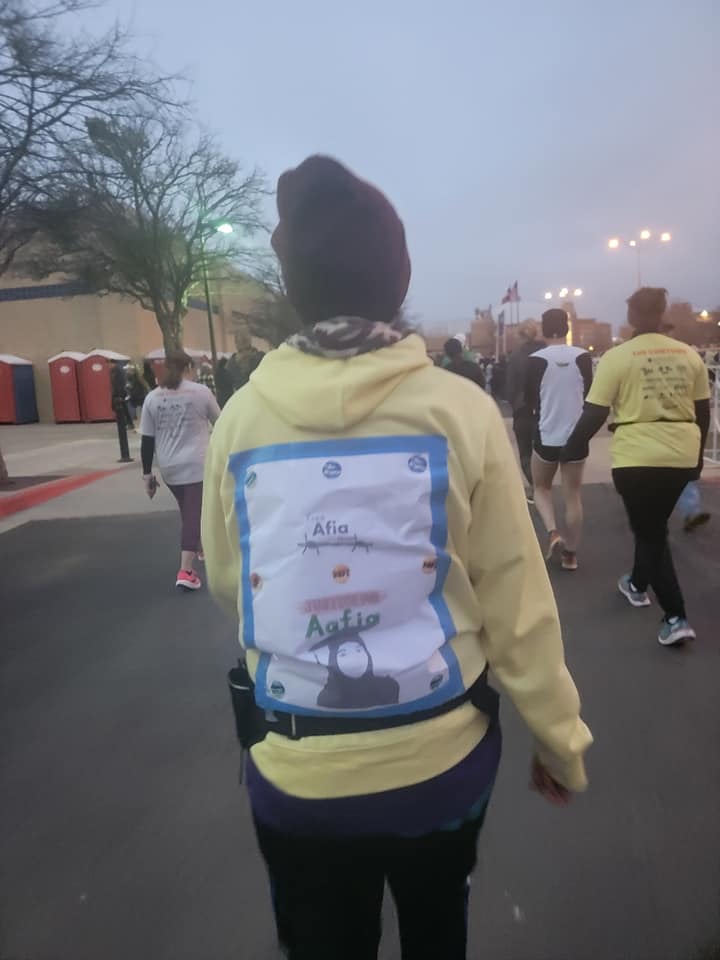
marathon, and the eighth one I’d used to call for the freedom of Dr. Aafia
Siddiqui. Running is all about freedom. Some people ride a motorcycle or drive
a Corvette for the purpose. Others snort cocaine. Still others ski the Swiss
Alps, or climb Mount Everest. I run for the elation, the ebullience, the high
that comes with prolonged exertion.
In prison, there is
no runner’s high. Dr. Aafia Siddiqui is held in a tiny prison cell in Fort
Worth, Texas. She is barely allowed out on the yard one hour a day, let alone
permitted to run. She is a diminutive figure, who even the CIA agents who saw
her categorized as “stick thin.” And she is accused of snatching a heavy duty
assault rifle, an M-4, placed on the ground by a soldier at a U.S. army base in
Afghanistan, and assaulting three big, burly U.S. servicemen. And if you believe
that official U.S. government version, I have a bridge to sell you in California.
Lies
and More Lies Against a Hafiza-e-Qur’an
If Aafia had shot
at the servicemen, there would have been bullet casings at the scene. There were
none. Aafia was the only person shot. In fact, she was shot three times in the
stomach, and almost died from it, due to delayed or non-existent medical
treatment.
Bullet casings
aside, there were not even any proper bullet holes to tie Aafia to the case.
Yes, there was a bullet hole in the wall where Aafia ostensibly fired at the
soldiers. And yes, the prosecution did its best to attribute the bullet hole to
Aafia’s putative firing of the firearm. But the incident occurred in a fort,
which is a secured building, and thus has video-monitoring. And- the video
clearly shows the existence of the bullet hole in question—prior to Aafia’s
arrival at the fort.
But, the video was
not available to the defense at the time of the trial, appeals of the verdict
were (suspiciously) dropped by Aafia, and the 86-year sentence, which included a
terror enhancement added by the judge (for a non-terror trial!), stuck. That’s
even though (excepting Aafia) not one person was killed or even injured. Talk
about Kafkaesque.
The
Real Victim of the Victimless “Crime”
Later on, while in
prison, Aafia lost part of her intestine. And one of her kidneys was removed.
When she appeared in court in New York, she was in a wheel chair. Her condition
was resultant from the injuries sustained during her capture and detention, as well
as the dearth of proper medical care. All of this was a clear violation of the
Geneva Convention.
A
Bit of Background About Me
(Skip
to next section if you know me)
I am a Pakistani
woman marathoner, one of very few. Leading up to today’s race, I’d run 48 full
marathons. Today would be Marathon #49. As far as I know, I hold the Pakistani
women’s record in terms of sheer numbers of full marathons run (keeping in mind
that a marathon, by definition, is 26.2 miles or 42.16 km). And I may possibly hold
the Pakistani women’s time record for the event as well. According to the Athletics
Federation of Pakistan (AFP), the Pakistani record was set by one Sadia Parveen,
who managed a 4:12 marathon finish at the Hong Kong Marathon in 2002. My PR
(record) is 3:41, achieved in 2015 at the NCR Marathon (Maryland, USA).
Sidebar:
Women and Athletics in Pakistan
Although women are
starting to run more and more in Pakistan, there are tremendous obstacles.
There are stray dogs in many areas, which make it physically dangerous. The
heat is stifling much of the year in many regions, with temperatures up to 120
degrees not uncommon.
Then, too,
community support for women running long distances is scant. The reason for
this may be the long-held and misplaced view that distance running interferes
with women’s fecundity. And, since children are considered the greatest wealth of
a community in many traditional cultures, anything interfering with conception
is frowned upon. Hence I received many warnings early on to ease up on the
running.
In addition to
myths about running’s interference with childbearing ability, Pakistani female
athletes face far more serious obstacles. In the Land of the Pure, women runners
risk everything from character assassination, heckling, groping, threats,
intimidation and assault while running outdoors. And unfortunately, hijab is no
protection, as I can personally attest. While this is purely anecdotal, I was
assaulted by a man I’d never met while running in loose fitting shalwar-kameez
and dupatta (head cover) in Pakistan. And I have heard similar stories from
other female athletes in Pakistan. Many who persist in the sport resign
themselves to indoor running at the gym. But this, too, is a limiting solution,
because in a poor country with no Planet Fitness, and gym fees being beyond the
reach of many ordinary Pakistani women, the gym is frequently the domain of Pakistani
upper class women.
All of that to say:
Recognizing the privilege of my circumstance, I don’t think it fair to compare
myself to Sadia Parveen or other athletes who have trained on Pakistani soil
under extremely harsh conditions.
Why
Run for Aafia?
I was in Chicago at
my own expense. No one was paying me to run for Aafia. Nor was she a blood
relative, despite the similarity in our surnames. I would gain neither fame nor
fortune by running for a Pakistani Muslim woman political prisoner, unapologetic
in her love for Islam, and who been labeled with the worst possible pejoratives.
I ran for Aafia because I was absolutely certain of her innocence. But it was not all about Aafia. I ran in her name,
too, because of what she symbolized: a completely innocent person rendered (kidnapped)
by vicious security forces during the U.S. “War on Terror,” her life shattered
through no fault of her own.
Many
Aafias
Hundreds of such innocents
were kidnapped, including children. Many of these were captured in Pakistan, by
the government of then-dictator Pervez Musharraf, a staunch U.S. ally. They
were taken to Guantanamo Bay, frequently after detention and torture at one of
seven U.S. black sites (“secret prisons”). Of the 779 prisoners originally held
at Guantanamo, 734 were released or transferred, with even the CIA admitting
that they were completely innocent. Tragically, nine of the detainees died in
Guantanamo, never to return home to the families who waited for them day after
day.
Following their
ordeal, a few of the released detainees somehow found the courage to write
their story. For example:
Enemy Combatant: My Imprisonment by the United States at Guantanamo by Moazzam Baigg
and
My Life with the Taliban by Abdul Salam Zaeef
Their health,
sanity, and sense of safety in the world destroyed, the Guantanamo detainees
struggled to rebuild their lives. Some detainees, of Arab origin, were returned
to Arab countries ruled by dictators. In these cases, the regime continued to
hound and harass them, as the label of “terrorist” had been smeared on them. While
the British government paid restitution to a small number of the detainees who
were British citizens, in no case was restitution made by the United States to
the former detainees for the illegal, lengthy detentions, separation from their
families, and tortures endured. This was despite the fact that the “War on
Terror,” in the course of which the detainees (including Aafia Siddiqui) were
captured, was instigated by the U.S.
A great book which
powerfully documents the “War on Terror” and its terrible impact on Muslims is:
Innocent Until Proven Muslim: Islamophobia, the War on Terror, and the Muslim Experience Since 9/11 by Dr. Maha Hilal
Race
Day
It is race day, and
I rise to say the fajr prayer. I don
my “Free Dr. Aafia Siddiqui” tee, and grab the few essential items I laid out
the night before: Power Bars, water bottle, gloves, hotel room key.
The starting line
is two miles away from the downtown hotel where I’m staying. There’s a free shuttle
with a nearby pickup point, which could get me to the start, but I elect not to
take it. I’m not a morning runner, and I need to wake my legs up, preferably
before I’m surrounded by throngs of people. The streets are dark as I jog
toward the start line. Luckily, I’ve walked the area in the previous days, and
recognize various cross streets.
The race starts in
Chicago’s renowned Grant Park. This is a huge city park, spanning many blocks.
Numerous side streets lead up to it. The race is so large that the organizers,
to avoid complete pandemonium, have assigned each runner a specific side street
from which to access the starting line. This is based on how fast the runner
was in a previous marathon, which she documented on her Chicago marathon
application. On her assigned street (which race organizers call a “gate”) is
the security checkpoint through which she—and all runners in her starting group—must
pass. The runner must display her bib (race) number, which is unique to her. It
is worn on the front of her shirt, and contains a timing device to record her exact
start and finish time, which are later used to calculate her finish time. (This
is done to ensure fairness, since, with 40,000 people running, everyone cannot possibly
cross the start line at the same time.) Non-runners are not permitted into the
area.
My assigned street
is Ida B. Wells Drive. The symbolism does not escape me. My “gate’ is named
after an extremely prominent, fearless Black woman leader. Originally a teacher
in segregated schools in the American South, she fought against lynchings and
for black women’s rights. And I am running for a Pakistani woman, Aafia, a
brilliant orator, scholar, and visionary in her own right, who sought to
revolutionize the Pakistani education system to benefit all Pakistani children,
including those with autism and other learning disabilities—until she was
kidnapped by Pakistani intelligence and handed over to the U.S. for torture.
My wave starts at
8:00 AM, one hour after the elites (professional athletes and other very fast
runners). So, I wait, praying, stretching, observing.
The
Race Starts
The race started,
as usual, after the singing of the National Anthem. Unlike some of the
marathons I’ve run, this city’s mayor, Lori Lightfoot, did not come out to kick
off the race. Perhaps it was just not a Chicago thing. Or it may have been that
she, an openly gay woman who frequently leads Chicago’s annual Pride (LGBTQ)
Parade, was too busy with her wife?
As a middle of the
pack marathoner, I view marathoning as an opportunity to see a new city on
foot. It is very empowering, and often changes one’s view of the city. In this
case, I’d run Chicago twice previously, and had a general sense of the city’s
layout.
According to the
organizers, the Chicago marathon traverses twenty-nine of the city’s neighborhoods.
Unlike some marathons, eg Baltimore and Washington, DC, which take runners
through a variety of neighborhoods, including both affluent and downtrodden
areas, the Chicago race seemed not very representative of the city. For example,
it avoided large swathes of Chicago’s South Side, reputed to be poor and
crime-ridden. It did, however, provide interesting glimpses into Chicago’s
ethnic diversity.
For example,
approximately 40% of Chicago’s population is Latino, a fact I’d been completely
unaware of prior to my first Chicago Marathon in 2018. And evidently, the Windy
City is home to a very large population of Latino distance runners. On top of
this, runners from all over Latin America converge on Chicago just to
participate in the race. Accordingly, marathon coverage by the sports channels
was provided in both English and Spanish, the Spanish language coverage by
Telemundo. Latinos lined the roads all along the route to cheer on their family
members who were running the marathon. Perhaps the largest group of these was
near Mile 18. They were playing beautiful, energizing Spanish music, waving the
flags of various Latin American countries, and chanting “Si se puede,” and
other words of encouragement entirely in Spanish. I noted with some amusement
that they would yell out in Spanish not just to the Hispanic runners, but also
to those who were clearly non-Hispanic.
As I ran, an old
friend in Brownsville, TX, came to mind. He is a Mexican convert to Islam, and
a long-time Aafia supporter. Prior to becoming seriously ill, he’d worked diligently
to educate his community both about Islam, and about the Aafia case. His
daughter, Aisha, frequently sported the “Free Dr. Aafia Siddiqui” tee distributed
by our campaign several years ago. I also thought of Nahela Morales, a Latina
convert and social justice activist with the Dallas-Fort Worth chapter of the Council on American Islamic Relations
(CAIR), who’d spoken passionately at a rally for Aafia outside of FMC Carswell
(prison where Aafia is locked up), and then launched the “#IAmAafia” campaign,
which reached thousands of people over social media.
I wondered if many Chicago-area
Latinos were aware of Dr. Aafia’s case. Given the xenophobia, racism, and
sometimes extreme hate directed at them, could they relate to her experience at
the hands of the U.S. government? Or were they more likely to swallow the government
propaganda against her?
A few miles down
the road, we ran under a gargantuan, ornate arch, and suddenly all of the signs
were in Chinese. It was the famed Chinatown Arch. For some reason, perhaps
because it occurs around Mile 22, by which time I am heavily fatigued, I didn’t
remember running under it during my previous two Chicago marathons. A member of
my support team was there, and shouted words of encouragement to me. We ran through
Chicago’s Chinatown. A Chinese band, complete with traditional Chinese gong and
other instruments, was playing. Chinese restaurants, furniture stores,
acupuncture shops, and herbalists—abounded. We left Chinatown, and headed back
toward downtown and Grant Park.
In the course of
the approximately four hours I was running for Aafia, fellow marathoners would
pass and gave me fist bumps, thumbs up, or verbal kudos. The last, and most
emphatic of these was a young Caucasian female runner. “Yes, yes, free ‘em
all!” she said. She, like most of the other runners interacting with me during
the race, was responding to the back of my shirt, which read “Free all
political prisoners!”
I was aware that the
front of my shirt, featuring a graphic of Dr. Aafia, and the words, “Free Dr.
Aafia Siddiqui!” unfortunately, could not easily be read by other runners
during the race. That is because it is a serious tripping hazard, to turn to
read another runner’s shirt in such a large crowd. However, the message was
visible to spectators. These lined every road we ran. And the shirt, with its
message, was visible to other runners during the lengthy waiting period to
start the race, as well as during the rest period afterwards, when exhausted
runners who had completed the marathon lounged about the “Recovery Area”
reserved for them in Grant Park.
All along the
course, spectators held their national flags. I recognized those of India, Mexico,
Canada, Britain, France, Norway, Spain, Italy, and many other countries. But there
were no Pakistani flags. And certainly no “Free Aafia” placards. It was late in
the race, and I was starting to get tired. I turned a corner, and saw a group
of spectators holding a large Palestinian flag. Several of them were also wearing
kaffiyahs (traditional Palestinian
scarves). They were there to cheer on the runners from Team Palestine, which
participates in the Chicago Marathon each year, to raise funds for the
Palestine Children’s Relief Fund (PCRF). As they had their eyes peeled for their
own team mates who were running (ie Palestinians), and I was still moving
pretty quickly, they didn’t see me at first. As I went past, I yelled as loud
as I could “Viva Viva Palestina!” And they smiled and raised their fists. I have
no idea why I yelled out in Spanish. But, it gave me a much needed surge of
energy, which propelled me across the finish line a few miles away.
As one crosses a
marathon finish line, one encounters a battery of volunteers. The first set of
these give the runner water. The next one puts a finisher medal around the
runner’s neck. The next volunteer places a heat shield (tin-like blanket)
around the runner. I had been noticing all along the course that there were
numerous volunteers of Pakistani appearance. Then, after I crossed the finish
line, I encountered the volunteers (a different group) giving out finisher
medals. A Caucasian male volunteer handed me a medal. I ordinarily don’t allow the
medal to be placed around my neck, as do most runners, as I think it will
obstruct the message of the Aafia shirt. The man congratulated me. Standing
right next to him was a young Pakistani man. He looked me straight in the eye
and said, “Great job! And by the way, I support your cause. Free Aafia
Siddiqui!”
It was my third
time running the Chicago Marathon, and the slowest of the three. My times were
4:04 in 2018; 4:18 in 2019; and 4:22 this year (2022). So, perhaps I was
slowing down with old age. Or not. Either way I could see the movement to free
Aafia growing on many different fronts. And I was sure that the youth, who naturally
gravitate to justice, would take the lead.
#FreeAafiaSiddiqui #ChicagoMarathon #RunningForJustice #BringInnocentAafiaHome #FreeAllPoliticalPrisoners #Pakistan
©
2022 Nadrat Siddique
Nadrat Siddique was born in Karachi,
Pakistan, but is currently based out of the Baltimore-Washington, DC area. She is
a runner, marathoner, activist and blogger for social justice, with a focus on
political prisoner issues. She is a member of the National Majlis Shura of
Jamaat al-Muslimeen.